Use this SALT deduction cap calculator to see your real cap for 2025 or 2026. The SALT deduction lets you deduct state and local taxes on your federal return if you itemize. From 2025 the cap went up from $10,000 to $40,000. It is $40,400 for 2026, and it rises 1% a year through 2029. For high earners, though, the higher cap is reduced by a phaseout. This SALT deduction cap calculator works out your actual 2025 or 2026 cap and how much of your state and local taxes you can deduct.
The 2026 figures come from the IRS notice on the 2026 SALT limit. The 2025 rules come from the Schedule A instructions.
What counts as SALT
- State and local income tax, or general sales tax (you choose one).
- State and local real estate (property) tax on your home and land.
- State and local personal property tax based on value, such as some car registration fees.
These go on Schedule A, lines 5a to 5c. The cap applies to their total.
Who this affects
SALT only helps if you itemize, which means your total itemized deductions must beat the standard deduction. The new cap matters most to homeowners in high-tax states such as California, New York, New Jersey and Illinois. It also matters to anyone with MAGI above $500,000 ($505,000 in 2026), where the phaseout begins.
How to use the SALT deduction cap calculator
- Choose the tax year (2025 or 2026) and your filing status.
- Enter state income tax (or sales tax), property tax, and personal property tax paid.
- Enter MAGI. For SALT this is AGI plus any excluded foreign earned income, foreign housing, or Puerto Rico, Guam or American Samoa income.
- Enter your other itemized deductions (mortgage interest, charity) to see whether itemizing beats the standard deduction.
The formula
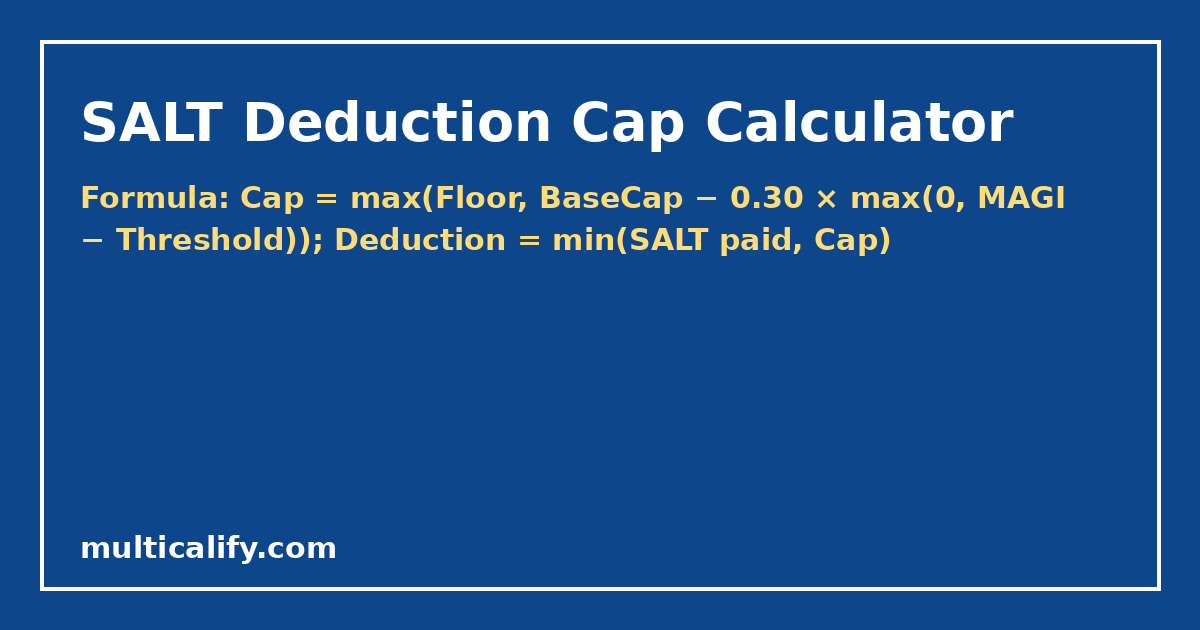
Reduced cap = Base cap − 30% × (MAGI − Threshold), but never less than $10,000 ($5,000 married filing separately).
SALT deduction = lesser of (taxes paid) or (reduced cap)
Base cap and threshold: 2025: $40,000 / $500,000. 2026: $40,400 / $505,000. Married filing separately use half of each.
Worked examples
Example 1: under the threshold
A New Jersey couple pays $14,000 in state income tax and $18,000 in property tax, $32,000 in total. Their 2026 MAGI is $320,000. They are under $505,000, so the cap is $40,400. They deduct the full $32,000. Under the old $10,000 cap they could only deduct $10,000.
Example 2: inside the phaseout
A single filer in California pays $55,000 in state and local taxes. 2026 MAGI is $560,000. Excess = $55,000. 30% × $55,000 = $16,500. Reduced cap = $40,400 − $16,500 = $23,900. The deduction is $23,900.
At about $606,333 MAGI and above in 2026, the cap falls to the $10,000 floor.
SALT cap by year
| Tax year | Cap (most filers) | Cap (MFS) | Phaseout threshold | Status |
|---|---|---|---|---|
| 2018–2024 | $10,000 | $5,000 | None | Official |
| 2025 | $40,000 | $20,000 | $500,000 | Official (IRS) |
| 2026 | $40,400 | $20,200 | $505,000 | Official (IRS) |
| 2027 | $40,804 | $20,402 | $510,050 | Set by the law’s 1% rule (IRS has not published yet) |
| 2028 | $41,212 | $20,606 | $515,151 | Set by the law’s 1% rule |
| 2029 | $41,624 | $20,812 | $520,302 | Set by the law’s 1% rule |
| 2030+ | $10,000 | $5,000 | None | Reverts under current law |
The 2027 to 2029 figures apply the 101%-per-year rule in the law to the 2026 base. The IRS will confirm the exact rounded amounts each year.
Single vs married: the same cap
The $40,000 / $40,400 cap and the $500,000 / $505,000 threshold are the same for single filers and married couples filing jointly. Married couples do not get a double cap. Married couples filing separately each get half: $20,200 for 2026, phasing out above $252,500, with a $5,000 floor. Filing separately rarely raises a couple’s total SALT deduction. It also costs other benefits, including the senior, tips, overtime and car loan interest deductions on Schedule 1-A.
Renters and people with no income tax
If you live in a state with no income tax, such as Texas or Florida, you can deduct general sales tax instead. Use the IRS sales tax tables, or add up your actual receipts. Renters cannot deduct property tax built into their rent.
Common mistakes
- Using AGI only. MAGI for SALT adds back excluded foreign income.
- Claiming both income and sales tax. You pick one, not both.
- Forgetting the $10,000 floor. No matter how high your income, the cap does not drop below $10,000.
- Itemizing when the standard deduction is larger. A higher cap does not help if your total itemized deductions are still smaller.
- Counting non-deductible items. Federal taxes, transfer taxes on a home purchase, and HOA fees are not SALT.
Tips
- Inside the phaseout, every $1 of extra income cuts the cap by 30 cents. This makes the effective marginal rate on that income higher. Timing bonuses, gains or conversions can help.
- Owners of pass-through businesses should ask about state pass-through entity tax (PTET) elections. These can work around the cap.
- Paying property tax early only helps if the tax has been assessed and you are under the cap in that year.
- Run both the itemized and standard options every year. The answer changes as the cap and your income change.
Our unique angle: the phaseout “tax on income”
Between $505,000 and about $606,333 of MAGI (2026, single or joint), each extra $1,000 of income removes $300 of SALT deduction. In the 35% bracket that adds about $105 of tax, so your effective rate on that income is about 45.5%. The SALT deduction cap calculator shows this hidden rate so you can see what a bonus or capital gain really costs.
Last reviewed: October 2026
Bookmark this SALT deduction cap calculator to rerun your numbers whenever your situation changes.
Related: income tax calculator · no tax on tips calculator · marriage tax calculator · UK salary tax calculator.