
Use this senior deduction calculator to see how much of the extra $6,000 you can claim. If you are 65 or older, you may be able to deduct an extra $6,000 from your taxable income each year from 2025 through 2028. A married couple who are both 65 or older can deduct up to $12,000. This “enhanced deduction for seniors” came from the One Big Beautiful Bill Act. This senior deduction calculator shows how much of it you keep after the income phaseout and what it is worth in tax.
The rules below follow Schedule 1-A, Part V and IRS guidance.
What the senior bonus deduction is
It is a temporary deduction on top of the deductions seniors already get. You still get the normal standard deduction and the existing additional standard deduction for age 65+. For 2025 that additional amount was $2,000 for single filers and $1,600 per qualifying spouse for married couples. The $6,000 is added on Schedule 1-A, and you can take it whether you itemize or not.
It does not make Social Security benefits tax-free. It lowers taxable income, which, for many retirees, cancels out the tax on part of their benefits.
Who qualifies
- You must be 65 or older by the end of the tax year. For 2025 the form asks whether you were born before January 2, 1961. For 2026, that means born before January 2, 1962.
- You need a valid Social Security number (and so does your spouse, for their share).
- If you are married, you must file jointly.
- Your MAGI sets how much you keep. The phaseout starts above $75,000 (single) or $150,000 (joint).
How to use the senior deduction calculator
- Choose your filing status.
- Tick how many people on the return are 65 or older (one or two).
- Enter your MAGI. For most people this is AGI from Form 1040, line 11. Add back any foreign earned income exclusion.
- Optionally, enter your marginal tax rate to see the tax saving.
The formula
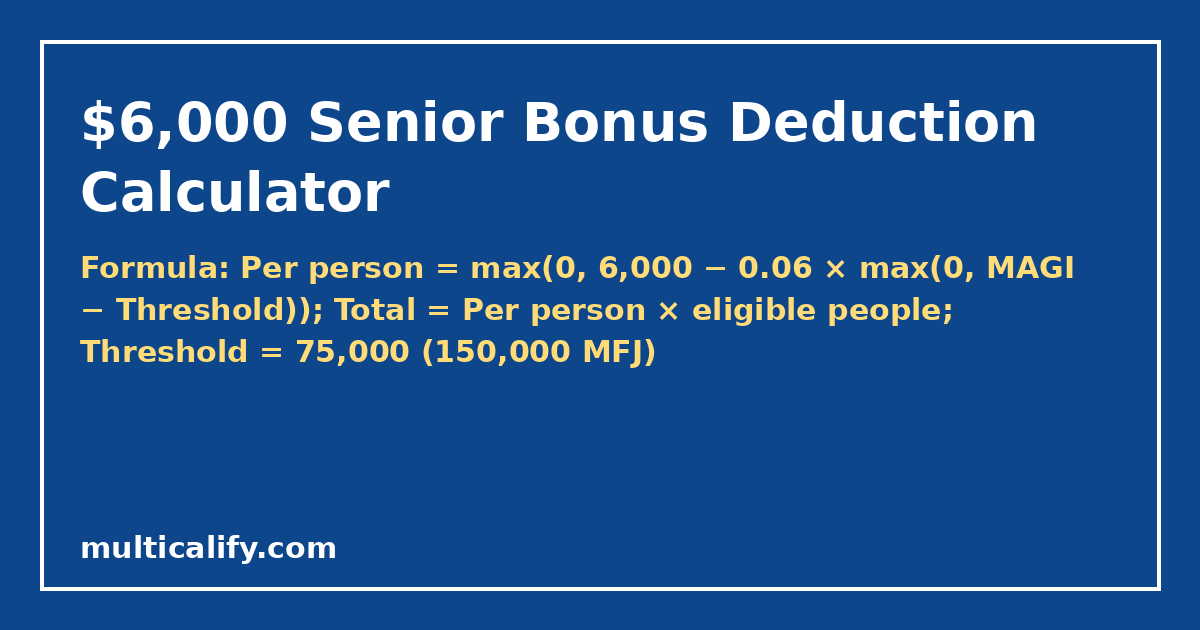
Per-person amount = $6,000 − 6% × (MAGI − threshold), not less than $0
Threshold = $75,000 single, $150,000 joint.
Total deduction = per-person amount × number of qualifying people (1 or 2)
Notice that the 6% reduction applies to each spouse’s $6,000. A couple with both spouses over 65 loses $120 of deduction for every $1,000 of MAGI over $150,000.
Worked examples
Example 1: single retiree under the threshold
Ruth is 70, single, and her MAGI is $60,000. She is under $75,000, so she gets the full $6,000. In the 12% bracket, that cuts her federal tax by about $720.
Example 2: couple in the phaseout
Frank (68) and Joan (66) file jointly with MAGI of $190,000. Excess = $40,000. 6% of $40,000 = $2,400. Each gets $6,000 − $2,400 = $3,600, for a total of $7,200. In the 22% bracket, that saves about $1,584. The deduction is fully gone at $250,000 MAGI.
Rules and limits
| Rule | Detail |
|---|---|
| Tax years | 2025 – 2028 |
| Amount | $6,000 per eligible person (up to $12,000 for a joint return) |
| Age test | 65 or older by the end of the tax year |
| Phaseout starts | MAGI over $75,000 single / $150,000 joint |
| Phaseout rate | 6% of the excess, applied to each person’s $6,000 |
| Fully phased out | $175,000 single / $250,000 joint |
| Itemizing | Not required |
| Married filing separately | Not eligible |
| Claimed on | Schedule 1-A, Part V |
Common mistakes
- Filing separately. Married couples lose the deduction on separate returns.
- Counting only one spouse. If both are 65+, claim both lines (36a and 36b).
- Ignoring the per-person phaseout. A couple loses the deduction twice as fast as a single filer.
- Confusing it with the regular additional standard deduction. They stack. One does not replace the other.
- Turning 65 in early January. If you were born on January 1, the IRS treats you as 65 on the previous December 31. That is why the 2025 cutoff is January 2, 1961.
Tips
- If you are near $75,000 or $150,000, look at timing for IRA withdrawals and Roth conversions. Every $1,000 above the line costs up to $60 per person in deduction.
- Qualified charitable distributions (QCDs) from an IRA lower AGI and help keep the deduction.
- Recheck withholding on your pension or Social Security (form W-4V). You may be overwithholding now.
- Remember it ends after 2028 unless Congress extends it, so long-term plans should not depend on it.
How it interacts with Social Security tax
The deduction does not change the formula for how much of your Social Security is taxable. That formula uses “combined income” (AGI + tax-exempt interest + half of benefits). What changes is the tax on the result: a $6,000 smaller taxable income can bring many middle-income retirees’ tax close to zero.
Who gets little or no benefit
If your taxable income is already zero, because the standard deduction covers all your income, an extra deduction saves nothing. That applies to many retirees who live mainly on Social Security. The deduction is not refundable, so there is no check for unused amounts. At the other end, single filers above $175,000 and couples above $250,000 get nothing. The biggest savings go to retirees with moderate pensions, IRA withdrawals or part-time wages who are in the 12% or 22% brackets.
Our unique angle: the “marginal cost” readout
Inside the phaseout, an extra $1,000 of income raises taxable income by $1,060 for a single senior, or $1,120 for a couple. Our calculator shows this effective marginal rate. That helps you decide how much to take from a traditional IRA or convert to Roth in a given year.
Last reviewed: October 2026
Bookmark this senior deduction calculator to rerun your numbers whenever your situation changes.
Results from this senior deduction calculator are estimates, so check them against official guidance before you file.
Related: 2027 Social Security COLA calculator · no tax on tips calculator · IRMAA 2027 calculator · Social Security calculator.