Use this car loan interest deduction calculator to estimate your yearly deduction. For tax years 2025 through 2028, you can deduct up to $10,000 a year of interest paid on a loan for a new, US-assembled personal vehicle. The deduction was created by the One Big Beautiful Bill Act (Public Law 119-21). This car loan interest deduction calculator estimates your yearly interest, applies the income phaseout, and shows the likely federal tax saving.
The IRS rules are in its guidance on the new deductions. You claim the deduction on Schedule 1-A.
What the deduction is
Car loan interest for personal vehicles had not been deductible since 1986. The new rule brings it back for a limited time and with tight conditions. It is a “below-the-line” deduction, so you can take it with the standard deduction. You do not need to itemize.
Who qualifies
The loan must:
- have been taken out (originated) after December 31, 2024;
- be used to buy the vehicle, with you as the first user, so used cars do not qualify;
- be for personal use, not business or commercial use;
- be secured by a lien on the vehicle.
The vehicle must be a car, minivan, van, SUV, pickup truck or motorcycle with a gross vehicle weight rating under 14,000 lbs, and its final assembly must have taken place in the United States. You can check final assembly with the NHTSA VIN Decoder. You must report the VIN on your return.
Leases do not qualify. Loans from family members or other related parties do not qualify. A refinance of a qualifying loan generally still qualifies, up to the amount refinanced.
How to use the car loan interest deduction calculator
- Enter the loan amount, APR, term in months and first payment date. The car loan interest deduction calculator builds an amortization schedule and adds up the interest due in each calendar year.
- Or, if you already have it, enter the interest from your lender’s year-end statement.
- Enter your MAGI and filing status.
- Enter your marginal tax rate to see the estimated saving.
The formula
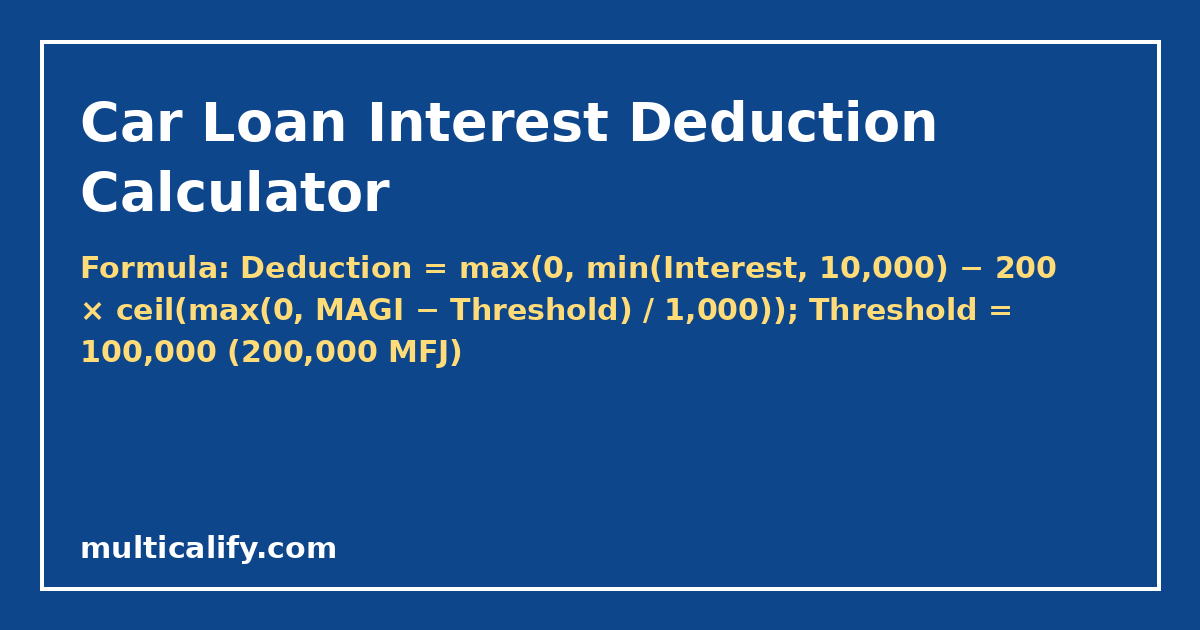
Base = lesser of interest paid in the year or $10,000
Excess = MAGI − $100,000 ($200,000 married filing jointly)
Reduction = $200 × (Excess ÷ $1,000, rounded up to the next whole number)
Deduction = Base − Reduction (not below $0)
Monthly interest in the schedule = remaining balance × (APR ÷ 12).
Worked examples
Example 1: new SUV, single filer
Dana borrows $40,000 at 7% for 60 months. Her first payment is in February 2026. Her payment is about $792 a month, and the 11 payments in 2026 include about $2,384 of interest. Her MAGI is $85,000, which is under $100,000, so she deducts all of it. In the 22% bracket, that saves about $525.
Example 2: married couple in the phaseout
A couple pays $4,000 of qualifying interest. Their joint MAGI is $212,500. Excess = $12,500, which rounds up to 13. Reduction = 13 × $200 = $2,600. Deduction = $1,400. At $250,000 MAGI the reduction reaches $10,000, so above that the deduction is fully gone, whatever the interest.
Rules and limits
| Rule | Detail |
|---|---|
| Tax years | 2025 – 2028 |
| Maximum deduction | $10,000 per return per year |
| Phaseout begins | $100,000 MAGI ($200,000 joint) |
| Phaseout rate | $200 per $1,000 or part of $1,000 over the threshold |
| Fully phased out | $150,000 single / $250,000 joint (at the $10,000 cap) |
| Vehicle | New, under 14,000 lbs GVWR, final assembly in the US |
| Loan | Originated after Dec 31, 2024, secured by the vehicle, personal use |
| Not eligible | Leases, used cars, business vehicles, related-party loans |
| Claimed on | Schedule 1-A, Part IV (VIN required) |
Common mistakes
- Assuming any “American brand” qualifies. It is the final assembly plant that counts, not the badge. Some US brands build models abroad, and some foreign brands assemble in the US.
- Deducting the whole payment. Only the interest part counts, not principal, insurance or fees.
- Claiming a 2024 loan. Loans taken out before 2025 do not qualify, even if you pay interest on them in 2025.
- Using a lease. Lease payments never qualify.
- Mixed use. If the vehicle is used for a business, check the IRS rules before claiming.
Tips
- Run the VIN through the NHTSA decoder before you buy, and keep a screenshot.
- Ask your lender for a year-end interest statement. Lenders of $600 or more in qualifying interest have new reporting duties.
- Remember the early years of a loan carry the most interest, so most of the benefit comes in years one and two.
- Compare the deduction with the effect of a lower rate or a bigger down payment. A deduction saves a share of the interest, but avoiding the interest saves all of it.
State taxes and other interactions
The deduction is federal. States decide on their own whether to follow it, and many have not. The deduction lowers taxable income but not AGI, so it does not help you qualify for credits that use AGI. If you also claim the tips, overtime or senior deductions, each one is figured separately on Schedule 1-A and the totals are added together.
If you sell or trade in the vehicle, the deduction stops for interest paid after the loan is paid off. If you roll negative equity from an old car into the new loan, the interest on that extra amount may not qualify, so ask a tax professional.
Our unique angle: calendar-year interest from your own schedule
Most calculators ask for “interest paid”, which buyers rarely know before tax time. Ours builds the amortization schedule from your loan terms and splits interest by calendar year. A loan taken out in September 2025 will show only a few months of interest for 2025 and a full year for 2026 to 2028, so you can see the total benefit over the life of the deduction.
Last reviewed: October 2026
Bookmark this car loan interest deduction calculator to rerun your numbers whenever your situation changes.
Results from this car loan interest deduction calculator are estimates, so check them against official guidance before you file.
Related: no tax on tips calculator · income tax calculator · SALT deduction cap calculator.