Use this Trump Account calculator to project your child’s balance. Trump Accounts are a new kind of individual retirement account (IRA) for children, created by the 2025 tax law (the “Working Families Tax Cuts” / One Big Beautiful Bill Act). Children born from 2025 to 2028 can get a one-time $1,000 deposit from the federal government. Families, employers and others can add up to $5,000 a year. This Trump Account calculator projects what the account could be worth when your child turns 18 and later.
Official details are on the IRS Trump Accounts page and in IRS Notice 2025-68.
What a Trump Account is
- A special IRA in the child’s name, opened by a parent, guardian or other authorised person.
- The money must be invested in mutual funds or ETFs that track the S&P 500 or another index of mainly US stocks.
- No contributions were allowed before July 4, 2026.
- Generally no withdrawals before January 1 of the year the child turns 18. After that the account generally follows traditional IRA rules.
Who qualifies
For an account: a child with a valid Social Security number who has not turned 18 by the end of the year the election is made.
For the $1,000 pilot deposit: a US citizen with a valid SSN, born between January 1, 2025 and December 31, 2028. A parent or guardian must make the election using Form 4547, either with their tax return or online through an IRS account.
Contribution rules
| Source | Limit | Counts toward $5,000? |
|---|---|---|
| Federal pilot deposit | $1,000 one time (births 2025–2028) | No |
| Parents, relatives, friends | Up to $5,000 per year combined | Yes |
| Employer (section 128 program) | Up to $2,500 per year, tax-free to employee | Yes |
| Government bodies / charities (qualified general contributions) | To a qualified group of children | No |
| Indexing | Limits rise with inflation after 2027 | — |
How to use the Trump Account calculator
- Enter the child’s birth year. The tool adds the $1,000 pilot deposit if the child was born in 2025–2028.
- Enter the yearly family contribution (0 to $5,000) and any employer contribution. The total is capped at $5,000.
- Pick an assumed annual return. The default is 7% before inflation. You can try 4%, 6% and 8%.
- Choose the age to project to: 18, 25, or retirement age.
The formula
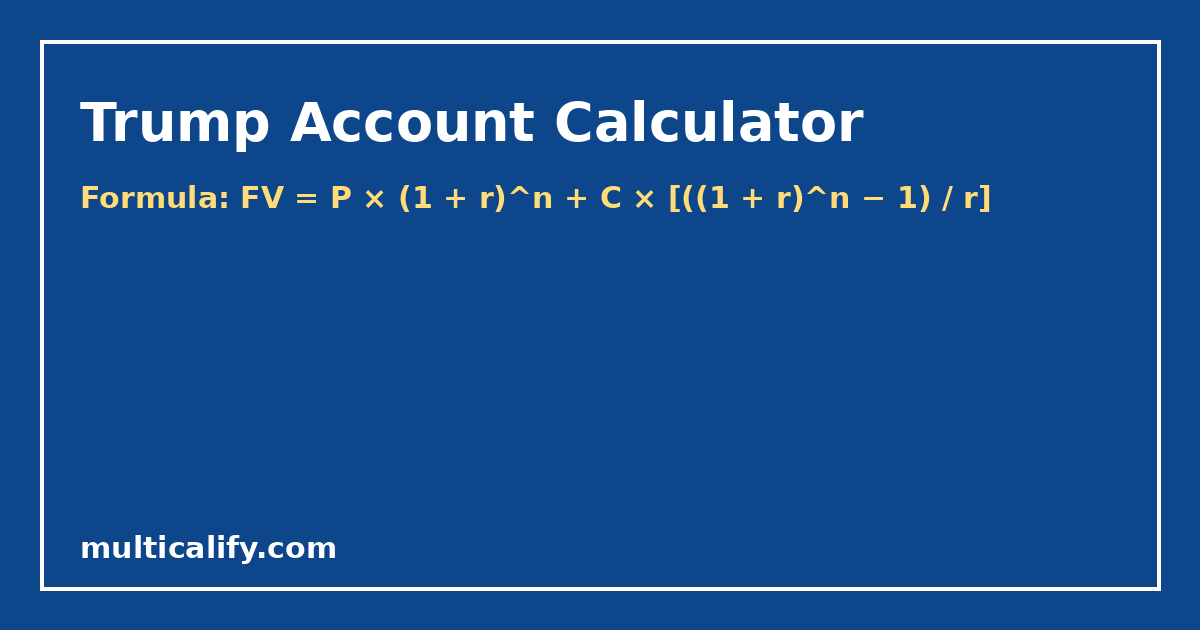
FV = P × (1 + r)n + C × [((1 + r)n − 1) ÷ r]
- P = starting deposit (the $1,000 pilot, if eligible)
- C = yearly contribution (at most $5,000, including employer money)
- r = assumed yearly return after fund fees
- n = number of years invested
Contributions are assumed at the end of each year. Contributions are only allowed until the year before the child turns 18. After that the balance just grows.
Worked examples
Example 1: pilot deposit only
A child born in 2026 gets $1,000, invested from 2026 at 7% for 18 years: $1,000 × 1.0718 ≈ $3,380. That is an estimate, not a promise.
Example 2: $1,000 plus $100 a month
Same child, with the family adding $1,200 a year for 17 years and growth until 18. $1,000 grows to ≈ $3,380. $1,200 a year for 17 years at 7% ≈ $37,010, which then grows one more year to ≈ $39,600. Total ≈ $43,000, from $21,400 of total deposits.
Common mistakes
- Thinking the $1,000 is automatic. A parent or guardian must file Form 4547 to elect it.
- Going over $5,000. Employer and family contributions share one yearly limit.
- Expecting a guaranteed return. The money is in stock index funds and can fall in value.
- Planning to spend it at 16. Withdrawals are generally not allowed before the year the child turns 18.
- Treating it like a 529. After 18, IRA rules apply. Withdrawals of earnings are taxable and early withdrawals may face a 10% penalty unless an exception (such as qualified higher education costs or a first home) applies.
Tips
- Make the election early, using Form 4547 with your return or online, so the pilot deposit starts growing sooner.
- Ask your employer whether it offers a Trump Account contribution program. The $2,500 is tax-free to you.
- Compare with a 529 plan for college and a custodial Roth IRA if your child has earned income. Each has different tax rules.
- Grandparents can contribute too. Keep a record so the family stays under $5,000 a year in total.
Trump Account vs 529 vs custodial Roth IRA
A 529 plan grows tax-free if the money is spent on qualified education. A custodial Roth IRA needs the child to have earned income, but qualified withdrawals are tax-free. A Trump Account needs no earned income and comes with the $1,000 pilot deposit for eligible children. It is taxed like a traditional IRA, though: growth is deferred, and earnings are taxed when withdrawn. Many families will use more than one.
Fees and investment choice
Fund fees reduce growth every year, so the Trump Account calculator’s return input should be after fees. Trump Account funds must be low-cost index funds. Check the expense ratio your trustee charges and update the rate if needed. Final Treasury regulations may add more detail on trustees and investments, so check IRS updates before you open an account.
Our unique angle: inflation-adjusted value
A “$43,000 at 18” headline can mislead. The Trump Account calculator also shows the projected balance in today’s dollars, using your chosen inflation rate (2.5% by default). So you see roughly what that money will buy, not just the nominal figure.
Last reviewed: October 2026
Related: investment calculator · savings calculator · Roth IRA calculator.