
Use this semaglutide mg to units converter to turn a prescribed dose into syringe units.
Medical disclaimer: This page and calculator are for education only. They are not medical advice and do not replace instructions from your prescriber or pharmacist. Always draw the dose your prescriber ordered, using the syringe and label your pharmacy supplied. If the semaglutide mg to units converter’s result does not match your instructions, do not inject. Call your pharmacist or prescriber first. If you think you have taken too much, contact Poison Control (1-800-222-1222 in the US) or emergency services.
Compounded semaglutide and tirzepatide often come in multi-dose vials labelled in milligrams per millilitre (mg/mL), while insulin syringes are marked in units. Converting between the two is where serious mistakes happen. The FDA has received reports of patients drawing 5 to 20 times their intended dose. This semaglutide mg to units converter turns a prescribed mg dose into mL and syringe units so you can check it against your pharmacy’s instructions.
Read the FDA’s warning: FDA alert on dosing errors with compounded semaglutide.
What this semaglutide mg to units converter does
It answers one question: for my prescribed dose and my vial’s strength, how far do I fill a U-100 syringe? It does not choose a dose, suggest increases, or tell you whether a drug is right for you.
Brand-name pens such as Ozempic, Wegovy, Mounjaro and Zepbound are pre-set and do not need this conversion. FDA-approved products have been reviewed for safety and quality. Compounded versions have not.
Who might use it
- Patients with a compounded vial who want to double-check the syringe mark given by their pharmacy.
- Caregivers helping someone with injections.
- Clinic staff preparing patient instructions (as a second check, not the only one).
How to use the semaglutide mg to units converter
- Find the concentration on the vial label, for example “2.5 mg/mL”. Some labels show the total mg in the vial and the total volume. Divide total mg by total mL to get mg/mL.
- Enter your prescribed dose in mg, for example 0.25 mg.
- Confirm the syringe type. Most are U-100 (100 units = 1 mL). A 0.3 mL, 0.5 mL or 1 mL U-100 syringe all use the same unit scale.
- Read the result in mL and units. Compare it to your pharmacy’s written instructions.
The formula
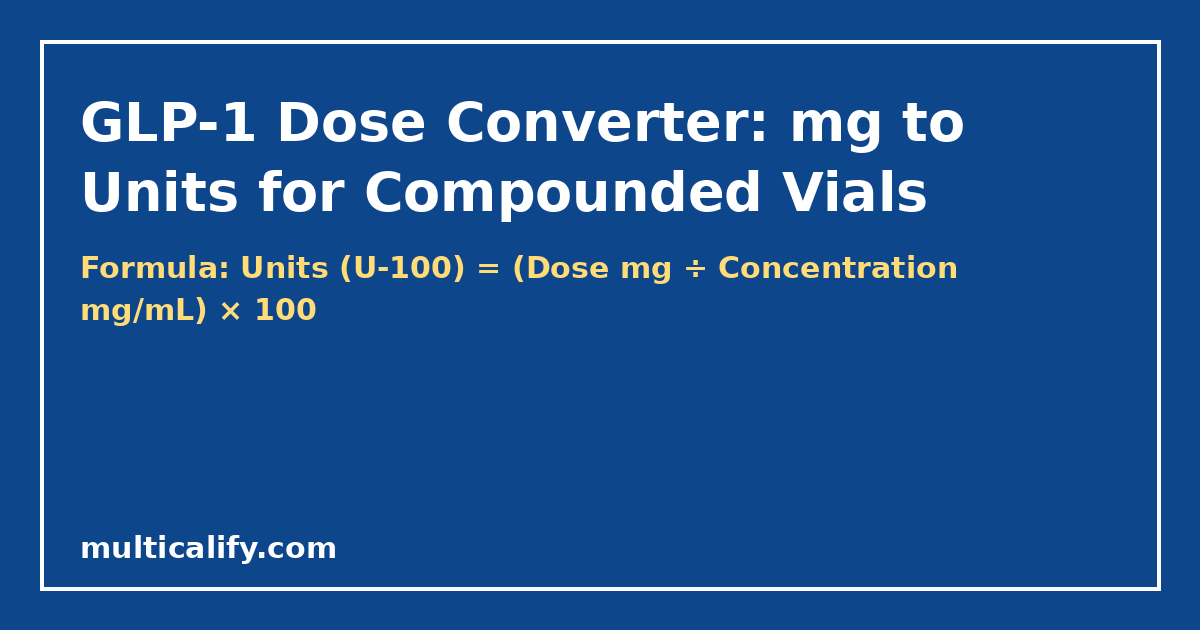
Volume (mL) = Dose (mg) ÷ Concentration (mg/mL)
Units on a U-100 syringe = Volume (mL) × 100
Put together: Units = (Dose mg ÷ mg/mL) × 100.
“Units” here is only a volume marking on the syringe. It is not a measure of drug strength, unlike insulin units. That mismatch is the root cause of many errors.
Worked examples
Example 1: semaglutide 2.5 mg/mL
Prescribed dose: 0.25 mg. Volume = 0.25 ÷ 2.5 = 0.1 mL. Units = 0.1 × 100 = 10 units. Drawing to “25” because the dose is 0.25 would give 2.5 times the dose.
Example 2: tirzepatide 10 mg/mL
Prescribed dose: 2.5 mg. Volume = 2.5 ÷ 10 = 0.25 mL. Units = 25 units. If the same patient later gets a 20 mg/mL vial, the same 2.5 mg dose is only 12.5 units. A change in vial strength always means a new syringe mark.
Quick reference table (U-100 syringe)
| Vial strength | Dose | mL | Units |
|---|---|---|---|
| Semaglutide 2.5 mg/mL | 0.25 mg | 0.10 | 10 |
| Semaglutide 2.5 mg/mL | 0.5 mg | 0.20 | 20 |
| Semaglutide 2.5 mg/mL | 1 mg | 0.40 | 40 |
| Semaglutide 5 mg/mL | 1 mg | 0.20 | 20 |
| Tirzepatide 10 mg/mL | 2.5 mg | 0.25 | 25 |
| Tirzepatide 10 mg/mL | 5 mg | 0.50 | 50 |
| Tirzepatide 20 mg/mL | 5 mg | 0.25 | 25 |
These are maths examples only, not dosing recommendations. Your vial may have a different strength.
Common mistakes
- Reading mg as units. “0.25 mg” does not mean 25 units unless the vial happens to be 1 mg/mL.
- Using the old mark after a refill. Pharmacies sometimes change vial strength. Check the label every time.
- Using a U-40 or U-500 syringe. Their unit scales differ. This semaglutide mg to units converter assumes U-100.
- Confusing a 0.5 mL syringe with 50 units. A full 0.5 mL U-100 syringe is 50 units. Check whether each line on yours is 1 or 2 units.
- Getting the dose from social media. Only your prescriber should set your dose and any changes.
Safety tips
- Ask the pharmacy to write the dose in mg, mL and units on the label or instructions.
- Get a pharmacist to show you the exact line to draw to the first time.
- Buy only from a state-licensed pharmacy with a valid prescription. The FDA warns about unapproved and counterfeit GLP-1 products sold online.
- Know the signs of too high a dose (severe nausea, vomiting, stomach pain, dizziness, signs of low blood sugar) and get help if they appear.
- Report problems to FDA MedWatch.
Regulatory note
The FDA has removed tirzepatide and semaglutide from its drug shortage list. That limits when pharmacies can lawfully compound copies of approved products. Compounded drugs are not FDA-approved, and the agency has published its concerns about unapproved GLP-1 drugs. Ask your prescriber which option is right and legal for you. If your vial’s label lists strength in a way you do not understand, such as total mg per vial with no mg/mL, ask the pharmacy to confirm the concentration in writing before your first dose.
Our unique angle: a “mismatch” warning
Enter the units your pharmacy told you to draw. If they differ from the calculated result by more than 10%, the tool shows a clear stop warning and tells you to call the pharmacy before injecting. It is a second check, not a replacement for professional advice.
Last reviewed: October 2026
Related: TDEE calculator · lean body mass calculator.