
Use this US import duty calculator to estimate US duties and fees on a shipment. This calculator estimates the US duties and fees on an import shipment. It covers the normal tariff rate, any extra tariff layers (Section 232, Section 301, Section 338), the Merchandise Processing Fee (MPF) and, for ocean freight, the Harbor Maintenance Fee (HMF). US tariffs have changed several times since 2025, so this page also explains what is in force as of October 2026.
For any real shipment, confirm your classification and rates in the official Harmonized Tariff Schedule (USITC) or with a licensed customs broker.
Where US tariffs stand in October 2026
- IEEPA tariffs are gone. On February 20, 2026 the Supreme Court ruled that the IEEPA “reciprocal” and related tariffs were unlawful. CBP has been processing refunds through its CAPE system.
- The 10% Section 122 tariff expired on July 24, 2026.
- Section 301 forced-labor tariffs of 10% or 12.5% apply to goods from 60 economies from July 2026, with some exemptions, including USMCA-compliant goods.
- Section 232 tariffs apply to steel, aluminum, copper, autos and parts, trucks, timber and lumber, semiconductors, pharmaceuticals, drones and more. Rates run from 10% to 100% depending on product and country.
- Other Section 301 actions include 25% on many Brazilian goods and the long-running China tariffs.
- Section 338 duties of 50% apply to selected Canadian goods.
- De minimis duty-free treatment (the old $800 rule) is still suspended. Low-value parcels owe duties.
Source: Congressional Research Service fact sheet R49481 (current as of September 30, 2026). Rates change often, so the US import duty calculator lets you enter each layer yourself and never assumes a rate for you.
Who should use this
Small importers, Amazon and Shopify sellers, people buying goods from overseas suppliers, and anyone pricing landed cost. The US import duty calculator is a planning tool. Your customs broker files the actual entry.
How to use the US import duty calculator
- Enter the customs value. That is usually the transaction value: the price paid for the goods, excluding international freight and insurance. Assists and some royalties must be added.
- Look up the HTS code for your goods and enter its general (MFN) duty rate as the HTS rate %. A free-trade agreement rate can replace it if you qualify.
- Add any extra tariff layers that apply (Section 232, Section 301 or Section 338) together in the additional tariff % field. Example: 25% + 7.5% = 32.5.
- Choose the value basis (goods only, or goods + freight + insurance as a conservative check) and ocean or air transport.
- Read the duty, MPF, HMF and total landed cost from the US import duty calculator. For a per-unit cost, divide the landed cost by the number of units.
The formula
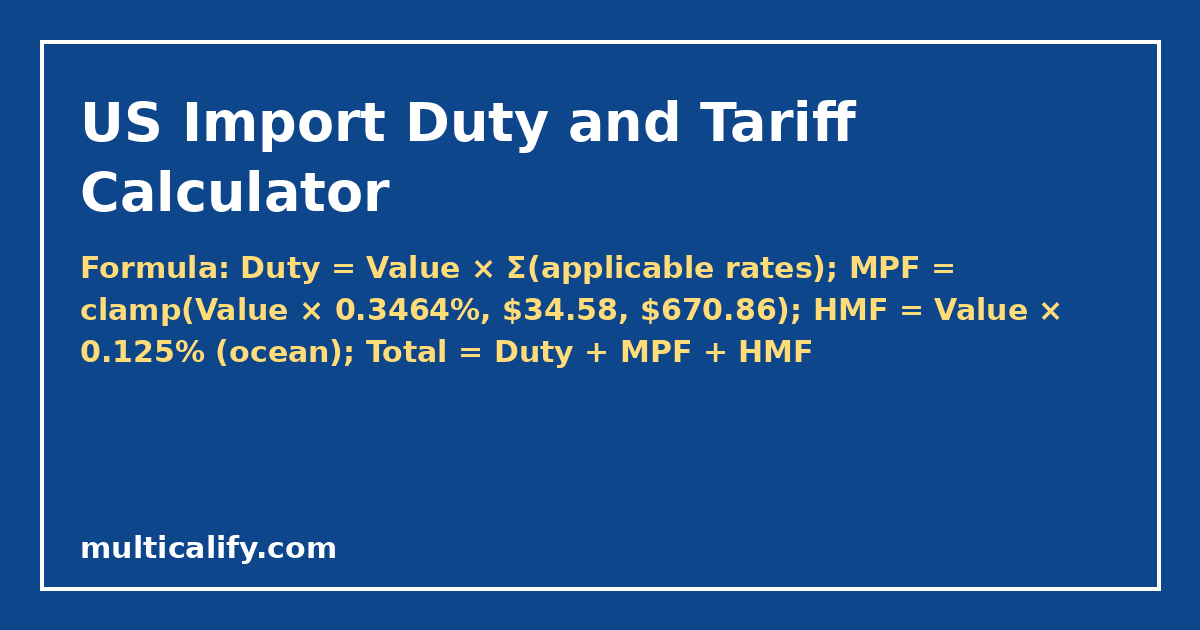
Duty = Customs value × (MFN rate + Section 232 + Section 301 + Section 338 + other)
MPF (formal entry) = Customs value × 0.3464%, kept between $34.58 and $670.86 (FY2027 limits, from October 1, 2026).
HMF (ocean only) = Customs value × 0.125%
Total cost = Duty + MPF + HMF. Landed cost = goods + freight + insurance + total cost + broker fees. Step-by-step examples are in our guide on how to calculate landed cost with tariffs.
Some layers do not stack. For example, goods covered by certain Section 232 actions may be exempt from other tariffs. The US import duty calculator has one additional-tariff field, so add up only the layers that actually apply to your goods.
Worked examples
Example 1: ocean shipment, apparel
Customs value $20,000. MFN rate 16% (example only, as rates vary by HTS line). The supplier’s country faces a 10% Section 301 forced-labor tariff. Duty = $20,000 × 26% = $5,200. MPF = $20,000 × 0.3464% = $69.28. HMF = $25.00. Total = $5,294.28.
Example 2: high-value air shipment of aluminum goods
Customs value $250,000. MFN 5%. Section 232 aluminum 50% (assume it applies and does not stack with other layers). Duty = $250,000 × 55% = $137,500. MPF = $866 by formula, capped at $670.86. No HMF by air. Total = $138,170.86.
HS Code vs HTS Code: Which Number Sets the Duty?
The first 6 digits are the international Harmonized System (HS) code, shared by WCO member countries. The US Harmonized Tariff Schedule (HTS) adds 2 digits to make the 8-digit legal line where the duty rate is set, and 2 statistical digits to make the 10-digit number used on the entry. All 10-digit numbers under one 8-digit line pay the same rate (USITC).
| Level | Digits | Example | Who sets it |
|---|---|---|---|
| HS heading | 4 | 0106 | WCO (international) |
| HS subheading | 6 | 0106.00 | WCO (international) |
| HTS rate line | 8 | 0106.00.50 | United States (duty rate) |
| HTS statistical number | 10 | 0106.00.5010 | United States (statistics) |
So an HS code alone is not enough to price US duty; look up the 8-digit HTS line and enter its rate.
Example: Duty and Fees on a $150 Shipment
A $150 courier shipment at an example HTS rate of 12% (check your own code): duty = $150 × 12% = $18.00. Shipments of $2,500 or less can usually use an informal entry, where the FY2027 automated MPF is $2.77 instead of the 0.3464% formula. Duty + MPF = $20.77, before any brokerage fee the carrier charges. No HMF applies by air.
The calculator applies the formal-entry MPF minimum to every shipment, so for a parcel this small, replace its MPF line with $2.77.
Fees and thresholds
| Item | Figure | Source / status |
|---|---|---|
| MPF rate (formal entry) | 0.3464% ad valorem | CBP, FY2027 |
| MPF minimum / maximum | $34.58 / $670.86 | Federal Register, 91 FR 48398 (from Oct 1, 2026) |
| Harbor Maintenance Fee | 0.125% (ocean only) | 19 CFR 24.24 |
| De minimis | Duty-free treatment suspended | CRS R49481 |
| IEEPA tariffs | Invalid; not collected since Feb 2026 | Supreme Court / CBP |
| Section 301 forced-labor tariffs | 10%–12.5%, 60 economies | USTR, 91 FR 47318 |
| Section 232 | 10%–100% by product and country | BIS / proclamations |
Informal entries and small parcels
Shipments valued at $2,500 or less can usually clear as informal entries, which have a lower, flat-rate MPF instead of the 0.3464% formula. With de minimis suspended, even small parcels from overseas sellers now owe duties, and postal or courier carriers may add their own brokerage charges.
Common mistakes
- Using the wrong HTS code. Classification drives every rate. Get a binding ruling from CBP if unsure.
- Adding freight to the customs value. The US uses FOB-style value. International freight and insurance are usually excluded.
- Assuming country of shipment is country of origin. Origin is where the goods were made or substantially transformed.
- Relying on old de minimis rules. Low-value shipments are no longer duty-free.
- Using early-2026 tariff tables. IEEPA and Section 122 rates no longer apply.
Tips
- Before you use the US import duty calculator, check whether your goods qualify under USMCA or another free trade agreement. Several tariff layers exempt qualifying goods.
- If you paid IEEPA duties in 2025–2026, ask your broker about CBP’s refund process.
- Build a buffer of 5–10% into pricing while Section 232 and 301 investigations remain open.
- Re-run the US import duty calculator whenever a rate changes, and sign up for CBP CSMS messages to hear about rate changes the day they happen.
Our unique angle: a layer-by-layer duty stack
Most duty calculators show one blended rate. This page lists each tariff layer with its legal authority, and the calculator keeps the HTS rate and the additional-tariff total in separate fields. Change one field and re-run to see what happens if an action ends, a deal lowers a rate, or the goods qualify for an exemption.
Last reviewed: October 2026
Related: margin calculator · interest rate calculator · sales tax calculator.
How this US import duty calculator works
This calculator estimates US duties and CBP fees from the values and rates you enter. It does not look up a Harmonized Tariff Schedule (HTS) code or country of origin. You supply the base HTS or most-favored-nation (MFN) duty rate and any additional ad valorem layers, such as Section 301 or Section 232 duties, as a combined extra percent.
Fields are goods value, international freight, insurance, customs value basis, the base duty rate, additional duties, and mode of transport. Choose transaction value (goods only, the typical US FOB basis) or a conservative goods-plus-freight-plus-insurance basis. Ocean mode adds the Harbor Maintenance Fee (HMF). Air or other modes do not. The result is a planning estimate, not a customs entry or broker quote.
Formula
Customs value is the goods value, or goods plus freight plus insurance if you choose that basis. Duty equals customs value times the sum of the rates you entered (base HTS or MFN rate plus additional duties). For a formal entry, the Merchandise Processing Fee (MPF) is 0.3464% of customs value, but never less than the official minimum or more than the official maximum. HMF, for ocean shipments, is 0.125% of customs value. Total fees and duties equal duty plus MPF plus HMF (if any).
As of fiscal year 2027, which began October 1, 2026, CBP’s published formal-entry MPF is 0.3464% with a $34.58 minimum and a $670.86 maximum. Informal entries use a flat MPF of $2.77 (automated, not prepared by CBP), $8.30 (manual, not prepared by CBP), or $12.45 (manual, prepared by CBP) instead of the 0.3464% formula. The on-page tool is built around the formal-entry percentage formula; for a small informal shipment, replace the MPF line with the flat fee that applies.
Worked example
An ocean shipment has a customs value of $8,000, a 5% MFN rate, and no extra tariff layers.
- Duty = $8,000 × 5% = $400.00
- Raw MPF = $8,000 × 0.3464% = $27.71, which is below the minimum, so MPF = $34.58
- HMF = $8,000 × 0.125% = $10.00
- Total duty and fees = $444.58
A larger air shipment shows the cap. Customs value $250,000, MFN 5%, plus a 50% Section 232 layer that you have confirmed applies: duty = $250,000 × 55% = $137,500. Raw MPF would be $866.00, so the fee is capped at $670.86. There is no HMF by air. Total duty and fees = $138,170.86.
| Customs value | 0.3464% (raw) | Formal MPF charged | Why |
|---|---|---|---|
| $8,000 | $27.71 | $34.58 | Minimum applies |
| $20,000 | $69.28 | $69.28 | Within the band |
| $250,000 | $866.00 | $670.86 | Maximum applies |
Key 2026 duty, fee, and de minimis rules
- CBP makes the final duty determination. Classify goods with the official HTS and confirm Chapter 99 measures (Section 301, 232, 338, and any exclusions) with a licensed broker.
- Formal-entry MPF for FY2027 (from October 1, 2026): 0.3464%, minimum $34.58, maximum $670.86, plus a $4.15 manual surcharge when it applies. These figures supersede the FY2026 formal minimum of $33.58 and maximum of $651.50, which applied from October 1, 2025 through September 30, 2026.
- HMF on merchandise imported through US seaports remains 0.125% ad valorem.
- Duty-free de minimis treatment for shipments valued at $800 or less is indefinitely suspended for merchandise arriving by all modes, including the international postal network, except for limited statutory exceptions such as qualifying bona fide gifts and personal articles accompanying travelers.
- Informal entry is generally available for shipments valued at $2,500 or less, subject to eligibility. Formal entry is required above that amount and for certain merchandise (for example, goods subject to quotas or antidumping or countervailing duties).
- In the United Kingdom, non-excise goods sent to Great Britain that are worth £135 or less are not charged Customs Duty; goods above £135, and excise goods of any value, can be. UK VAT rules are separate from Customs Duty.
Frequently asked questions
What is the current formal-entry MPF minimum and maximum?
From October 1, 2026, CBP lists a $34.58 minimum and a $670.86 maximum, with the ad valorem rate unchanged at 0.3464%. Use those official figures for planning, and confirm the fee on the entry summary.
Is the old $800 de minimis exemption still available?
No. CBP has indefinitely suspended duty-free de minimis treatment for merchandise valued at $800 or less, for postal and non-postal shipments, with only narrow exceptions such as qualifying gifts and accompanying personal articles.
Does this calculator look up my HTS code?
No. You enter the base duty rate and any additional stacked rates. Look up classification in the official HTS, then type those percents into the fields.
When is the Harbor Maintenance Fee charged?
HMF is 0.125% of the merchandise value for imports through US seaports. Choose ocean mode to include it. Air, truck, and rail shipments are not assessed this harbor fee in the same way, so use air or other mode to omit it.
What should I use for a $150 courier parcel?
Duty is still customs value times the applicable rates, because de minimis is suspended. A $150 shipment will often qualify as an informal entry, where automated MPF is a flat $2.77 rather than the formal 0.3464% formula (which would otherwise be lifted to the $34.58 formal minimum). Carrier brokerage charges may be extra.
What a DHL, FedEx or UPS “merchandise processing fee” actually is
The Merchandise Processing Fee is a U.S. Customs and Border Protection charge, not a product the courier invented. When a DHL, FedEx or UPS invoice lists “MPF,” that line is usually CBP’s fee being passed through, sometimes next to the carrier’s own brokerage or disbursement charge. You do not pay two federal MPFs on the same entry. You may still pay the carrier for handling the entry.
This calculator estimates CBP duty, formal-entry MPF and, if you include it, harbor maintenance fee. It does not add a courier brokerage fee. If your delivery invoice is higher than the result here, look for a separate brokerage or “advancement” line, not a second official MPF rate.
How to read the carrier invoice
Match the MPF amount to the formal or informal CBP method already described on this page. A small informal shipment should look like the flat informal fee, not the formal 0.3464% formula with the formal minimum. If the courier’s MPF line is far above either official figure, ask the broker whether brokerage or other service charges were bundled into the same description.
US import tariff calculator with an HS or HTS code
CBP duty is assessed on the US Harmonized Tariff Schedule classification, a 10-digit HTS number. An HS code is the international stem of that number, usually six digits, and it is not enough on its own to set the US rate. Look up the 10-digit HTS and the duty rate that goes with it, then enter that rate here. This US import duty calculator applies the rate you type, then adds the merchandise processing fee and, for ocean shipments, the Harbor Maintenance Fee, using the 2026 formal MPF range of $34.58 to $670.86 at 0.3464%.
The tool does not look up HTS codes or Section 301 or 232 lists for you. You still have to classify the product, or have a broker do it, before the duty-and-fee sketch on this page is meaningful.
How do I use an HS code in this US import duty calculator?
Use the HS code to find the 10-digit US HTS number and its duty rate, then enter that rate and the customs value. The HS code alone does not set the US tariff.
Can I use this as a US customs duty calculator?
Yes, for a duty-and-fee sketch from a rate you already have. It will not classify your product or replace a customs broker.
More questions
What is a merchandise processing fee on a DHL, FedEx or UPS bill?
It is usually CBP’s MPF, billed by the carrier because the carrier or its broker filed the entry. It is not an extra federal tariff with a different rate.
Do I pay MPF to both CBP and the courier?
No. There is one CBP MPF on the entry. The courier may also charge its own brokerage or disbursement fee, which this calculator does not include.
Why is the carrier fee higher than this calculator?
The tool estimates official duty and CBP fees. Carrier brokerage, storage, or advancement charges sit outside that estimate and should be listed separately on the invoice.