Use this salary sacrifice pension cap calculator UK to see the extra National Insurance under the new cap. From 6 April 2029, only the first £2,000 a year of pension contributions made through salary sacrifice will be free of National Insurance contributions (NICs). Anything sacrificed above £2,000 will attract both employee and employer Class 1 NICs. Income tax relief is not affected. This salary sacrifice pension cap calculator UK shows how much extra NI you and your employer would pay under the new cap.
The policy was announced at Autumn Budget 2025. See the GOV.UK guidance on salary sacrifice changes from April 2029.
What is changing
Under salary sacrifice, you agree to a lower gross salary and your employer pays the difference into your pension. Today, the sacrificed amount escapes income tax and both employee and employer NICs, which is why it beats ordinary “net pay” or “relief at source” contributions.
From April 2029:
- The first £2,000 sacrificed per year stays NI-free.
- Sacrifice above £2,000 is treated like ordinary employee pension contributions for NI: employee and employer NICs are due.
- Income tax relief continues as now (within the usual annual allowance).
- Ordinary employer pension contributions (not salary sacrifice) stay NI-free.
Who is affected
Anyone who sacrifices more than £2,000 a year into a pension. That is about £167 a month. For example, someone on £40,000 sacrificing 5% (£2,000) is right at the cap. Higher earners and people who sacrifice bonuses will be hit the hardest. The government says most employees making typical contributions will not be affected.
A March 2026 Treasury letter to peers said the cap will apply per employment. Some details, such as whether it works per pay period or on an annual basis, were still to be decided. HMRC will publish payroll guidance before April 2029.
How to use the salary sacrifice pension cap calculator UK
- Enter your annual gross salary before sacrifice.
- Enter your annual sacrifice amount (or a percentage).
- Choose your NI category (standard category A is the default).
- See NI-free sacrifice, NI-able excess, extra employee NI, extra employer NI and your change in take-home pay.
The salary sacrifice pension cap calculator UK uses the current 2026/27 rates and thresholds, because 2029/30 rates have not been set. It will be updated when they are.
The formula
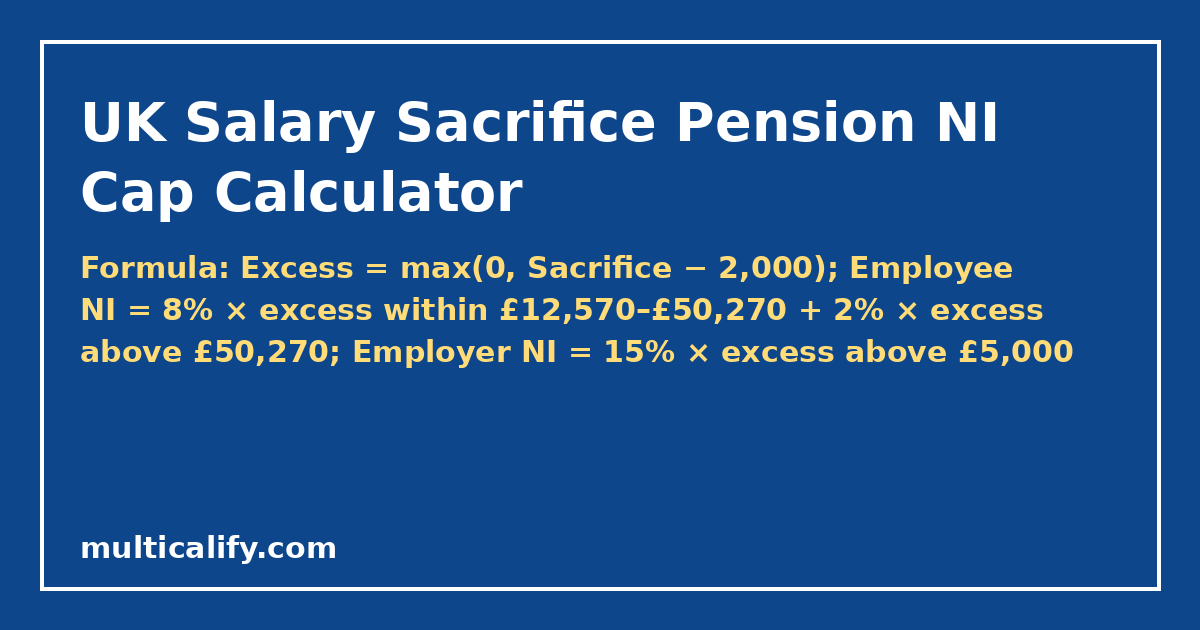
Excess = max(0, annual sacrifice − £2,000)
Extra employee NI = the part of the excess that falls between the primary threshold (£12,570) and the upper earnings limit (£50,270) × 8%, plus the part above £50,270 × 2%.
Extra employer NI = excess above the secondary threshold (£5,000) × 15%.
The excess is the “top slice” of your original salary, running from (salary − sacrifice + £2,000) up to your full pre-sacrifice salary.
Worked examples
Example 1: £40,000 salary, 8% sacrifice
Sacrifice = £3,200. Excess over cap = £1,200. That slice sits between £38,000 and £39,200, inside the 8% band. Extra employee NI = £96 a year. Extra employer NI = £1,200 × 15% = £180.
Example 2: £60,000 salary, 10% sacrifice
Sacrifice = £6,000, so the excess is £4,000. That slice runs from £56,000 to £60,000, all above the £50,270 upper limit, so the employee rate is 2%. Extra employee NI = £80. Extra employer NI = £4,000 × 15% = £600. The employee loss is small, but if your employer was sharing its NI saving with you as a pension top-up, that £600 saving disappears.
Rules and rates used
| Item | Figure | Status |
|---|---|---|
| Start date | 6 April 2029 | Official (HMRC/HM Treasury) |
| NI-free salary sacrifice cap | £2,000 per year, per employment | Official; some operational details pending |
| Employee NI main rate | 8% (£12,570 – £50,270) | Current rate; 2029/30 not yet set |
| Employee NI upper rate | 2% above £50,270 | Current rate |
| Employer NI rate | 15% above £5,000 | Current rate (since April 2025) |
| Income tax relief | Unchanged | Official |
| Employer (non-sacrifice) contributions | Still NI-free | Official |
What the cap does not change
Your take-home pay before 2029 does not change. Your pension pot gets the same amount each month whether NI is due or not, unless your employer changes the scheme. Workplace auto-enrolment minimums still apply, and the annual allowance (currently £60,000 for most people) is a separate income tax limit. If you are self-employed, salary sacrifice does not apply to you at all.
Common mistakes
- Thinking tax relief is ending. Only the NI advantage above £2,000 goes. Income tax relief stays.
- Applying 8% to everyone. Higher earners pay just 2% employee NI on the excess, so their personal loss is small.
- Ignoring the employer side. The employer’s 15% is usually the bigger cost and may change what your employer offers.
- Assuming it starts now. The cap applies from April 2029, not before.
- Stopping pension saving. Even with NI on the excess, sacrifice still gets full income tax relief.
Scotland, Wales and Northern Ireland
National Insurance is UK-wide, so the cap and NI rates are the same everywhere. Income tax relief on the sacrifice still follows your own rates, so a Scottish taxpayer’s income tax saving uses Scottish bands.
Tips
- Use the salary sacrifice pension cap calculator UK to compare your options, and ask your employer whether it passes on part of its NI saving. If it does, check what will happen after 2029.
- If you sacrifice a bonus, look at whether a different split over tax years makes sense once rules are finalised.
- Higher-rate taxpayers near £100,000 should keep using sacrifice to protect the personal allowance. The income tax effect remains.
- Re-run the salary sacrifice pension cap calculator UK once HMRC publishes final guidance. Check HMRC guidance closer to 2029. The rates and operating rules may change.
Our unique angle: employer impact and who pays the cost
Most coverage only looks at the employee. This salary sacrifice pension cap calculator UK shows the extra employer NI side by side, and works out how much of any “NI-saving pass-back” would be lost. For many staff that is the real change to their total reward.
Last reviewed: October 2026
Bookmark this salary sacrifice pension cap calculator UK to rerun your numbers whenever your situation changes.
Related: pension calculator · retirement calculator · UK salary increase calculator.